The architecture of shared money
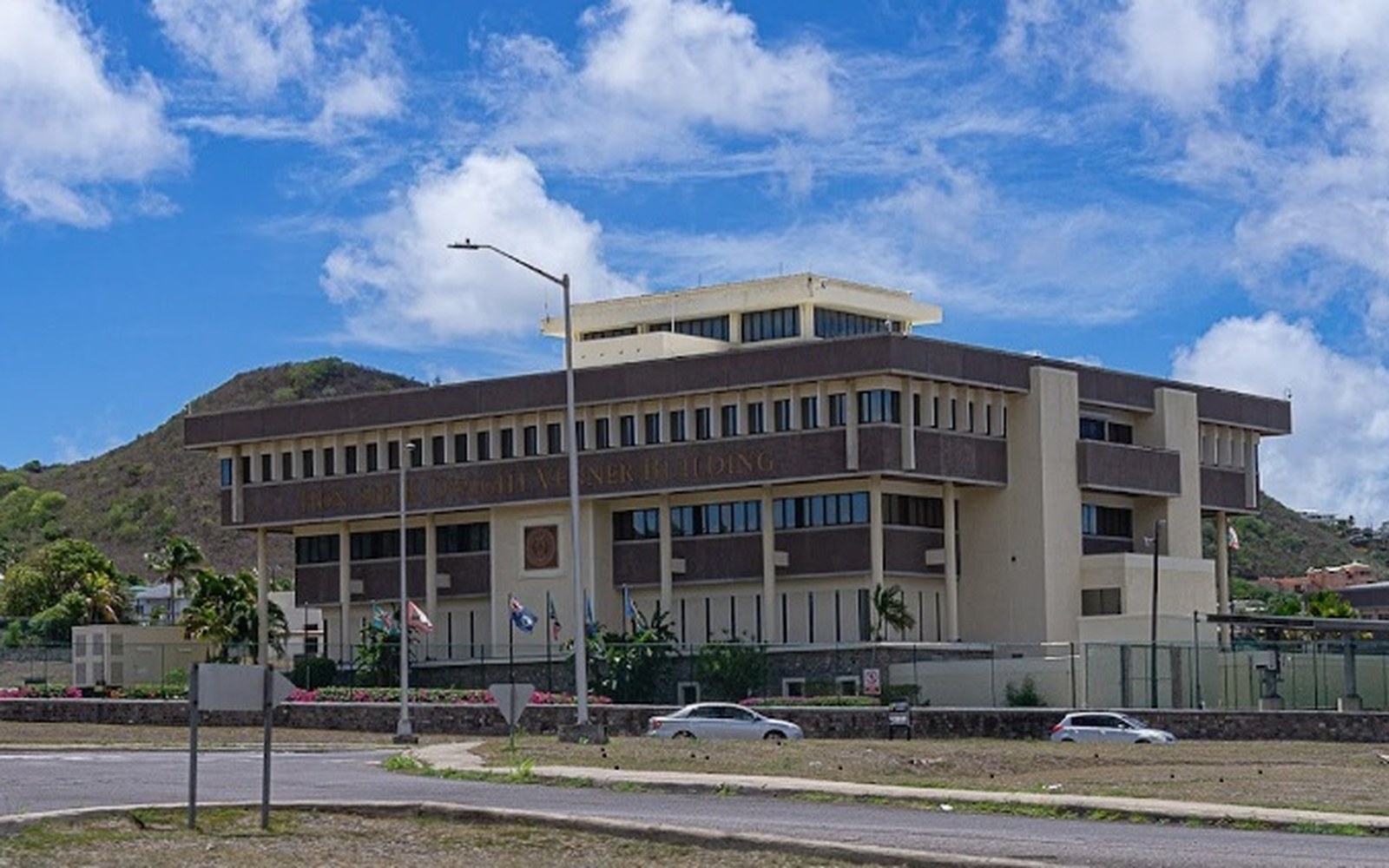
The Eastern Caribbean Central Bank — the ECCB — sits in Basseterre, St Kitts, and issues the Eastern Caribbean dollar for a membership that runs from Anguilla in the north to Grenada in the south. The eight participating governments are Antigua and Barbuda, Dominica, Grenada, Montserrat, St Kitts and Nevis, St Lucia, St Vincent and the Grenadines, and Anguilla as a non-independent territory. That lineup spans volcanic arc islands — including Dominica and St Vincent with their active geothermal systems — and lower-lying carbonate-influenced islands like Barbuda, yet all of them carry the same banknotes and answer to the same reserve requirement.

Islands that use the euro — Guadeloupe and Martinique are departments of France inside the EU, so the border and the currency in the middle of the arc are European ones.
Fort-de-France - 2014 - Fort Saint-Louis (3) · Wikimedia Commons
The currency itself has been pegged to the US dollar at EC$2.70 to US$1.00 since July 1976. That rate has not moved in nearly five decades. The IMF has repeatedly reviewed it and found it broadly appropriate to the region's trade structure, given that the United States is the dominant source of tourists and remittances for most member states. But a peg is not a passive choice: it outsources monetary policy entirely. The ECCB cannot lower its interest rate to stimulate a hurricane-battered economy without risking the peg; it cannot raise rates above the gravitational pull of Federal Reserve policy without attracting flows that distort its small financial systems. Fiscal policy — government spending and taxation — is the only macroeconomic lever each member government actually holds, and even that lever is constrained by the fact that the bank will not print money to cover a deficit.
What the bank actually does
The ECCB's mandate goes beyond issuing currency. It functions as a lender of last resort to member commercial banks, supervises the financial sector across all eight jurisdictions, and manages a shared pool of foreign exchange reserves that must cover a statutory minimum of sixty percent of the currency in circulation. That reserve requirement is the mechanical guarantee behind the peg: as long as the bank holds sufficient US dollars, it can honour every EC dollar presented for conversion.
The bank also publishes the economic data that these small states would struggle to generate independently. GDP estimates, balance of payments figures, inflation readings — for territories with statistical offices measured in single digits of staff, the ECCB provides a regional infrastructure that substitutes for what each island cannot sustain alone. The OECS, the Organisation of Eastern Caribbean States, handles broader economic integration across a similar membership, but monetary authority rests exclusively with the bank.
The peg's political economy
A shared currency among eight sovereigns — or near-sovereigns — requires that no single member can be bailed out by money creation. When a government overspends, it must borrow commercially or from multilateral institutions; the ECCB will not monetise the debt. This has kept inflation remarkably stable across the zone for decades, a genuine achievement in a region where external shocks arrive regularly in the form of named Atlantic storm systems, commodity price swings, and the periodic collapse of a tourism season. After Hurricane Maria struck Dominica in 2017, the island's government had to seek IMF and bilateral support — the ECCB could provide liquidity to the banking system but could not manufacture a fiscal response.
The arrangement also means that monetary union long predates the political one CARICOM has never fully achieved. The EC dollar area has functioned since 1965, first under the East Caribbean Currency Authority and then under the ECCB established by treaty in 1983. Forty years of shared banknotes have not produced a common parliament, a common passport or free movement of labour across all eight territories — those ambitions remain partly aspirational inside the wider CARICOM framework. What the bank delivers is narrower and more durable: price stability, a credible exchange rate, and a supervisory framework that no individual micro-state could replicate on its own budget. In a region defined by smallness, that is a concrete institutional achievement worth examining on its own terms.