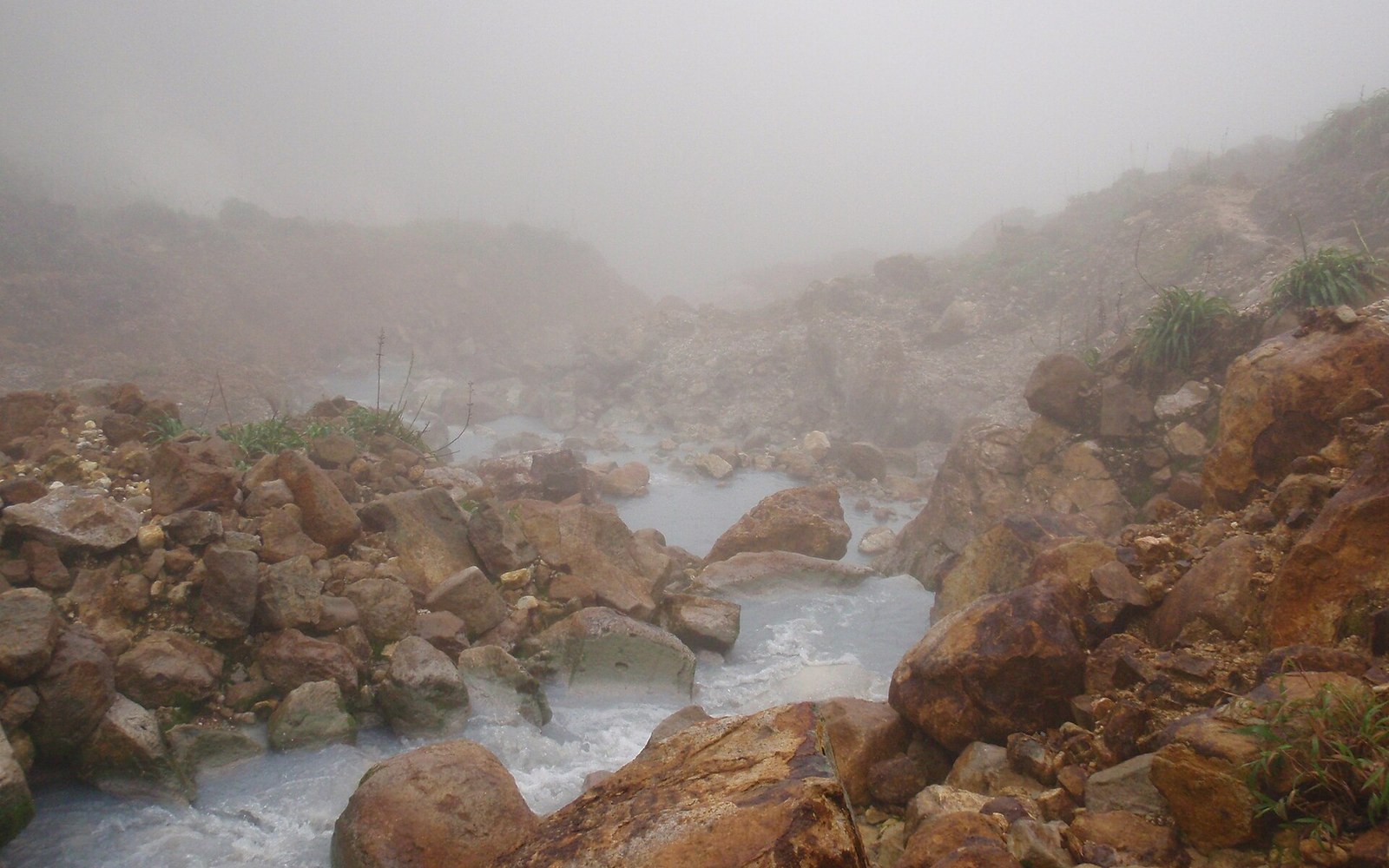
A Fumarole Under Water
The Boiling Lake is not a crater lake in the conventional sense. It is a flooded fumarole — a vent where superheated gases escape from magma below — and the water above it is kept in a state of near-continuous grey-blue roiling by that heat. Sitting inside the Valley of Desolation in Dominica's Morne Trois Pitons National Park, it is among the largest boiling lakes in the world, with surface temperatures typically measured between 82 °C and 92 °C at the edges, and an indeterminate centre that boils and fumes too violently to measure with any precision.
Getting there requires a serious hike: roughly six to seven hours return from the village of Laudat, through a landscape that makes Dominica's volcanic character impossible to ignore. The Valley of Desolation below the lake is itself a field of steaming vents, sulphur-encrusted rock and hot springs — hydrothermal activity spread across open ground, not contained in a museum exhibit. The lake periodically drains and refills as subsurface pressures shift; it effectively emptied in 2004 and again briefly in 2016, which is a reminder that the system is dynamic rather than decorative.
Morne Trois Pitons was inscribed as a UNESCO World Heritage Site in 1997, the first natural World Heritage Site in the Eastern Caribbean. The designation recognises the concentration of volcanic features — boiling lake, fumaroles, freshwater lakes, cloud forest — within a compact area.
Energy, Not Just Spectacle
Dominica's geothermal resource extends well beyond what a hiker can see. The island sits squarely on the volcanic arc that runs down the Lesser Antilles, and subsurface heat is abundant enough to support electricity generation at meaningful scale. Geothermal exploration has been underway in the Wotten Waven area since the early 2010s, with drilling confirming high-temperature reservoirs. The long-stated ambition is to generate enough electricity not only to meet Dominica's own demand but to export power via submarine cable to neighbouring islands — Martinique and Guadeloupe, both French departments with their own energy costs, have been named as potential customers.
Progress has been slower than the timeline originally suggested, with financing, cable infrastructure and regulatory alignment across jurisdictions all presenting friction. But the underlying geology is not the constraint. An island of roughly 72,000 people sitting on a heat resource of this scale has an obvious case to make, and the Boiling Lake, for all its drama as a tourist destination, is really just the most visible expression of an energy question that Dominica has not yet fully answered.