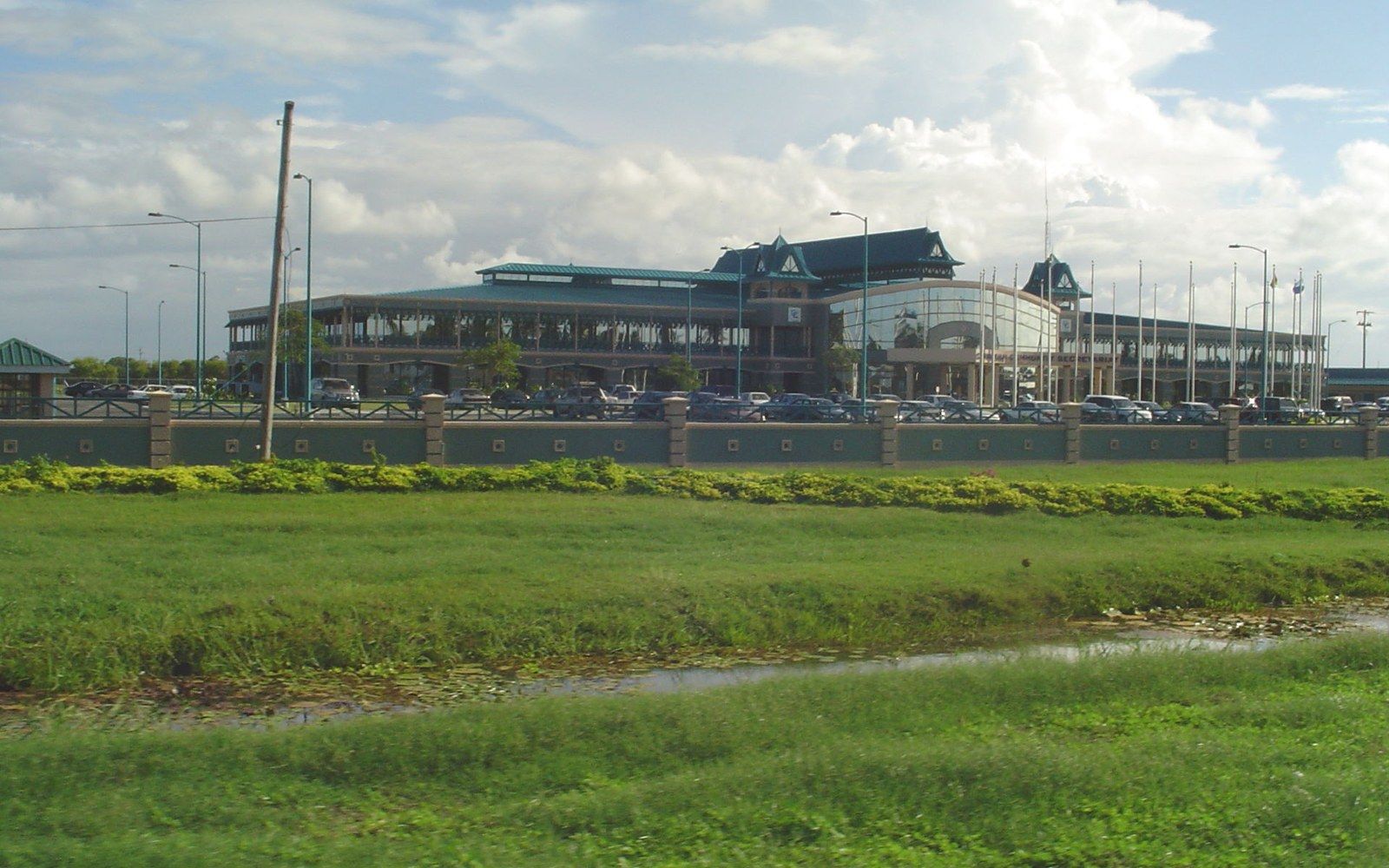
The treaty and what it promised
On 4 July 1973, four governments — Barbados, Guyana, Jamaica and Trinidad and Tobago — signed the Treaty of Chaguaramas in Trinidad, bringing the Caribbean Community into existence. CARICOM, as it is universally known, was not conjured from nothing: it succeeded CARIFTA, the Caribbean Free Trade Association that had operated since 1968, and it carried forward both CARIFTA's ambitions and its unresolved tensions. The 1973 treaty promised a common market, coordinated foreign policy, and functional cooperation across health, education and transport. What distinguished CARICOM from a standard free-trade club, at least on paper, was the depth of integration it envisaged — not just tariff removal between members but a genuine single economic space.
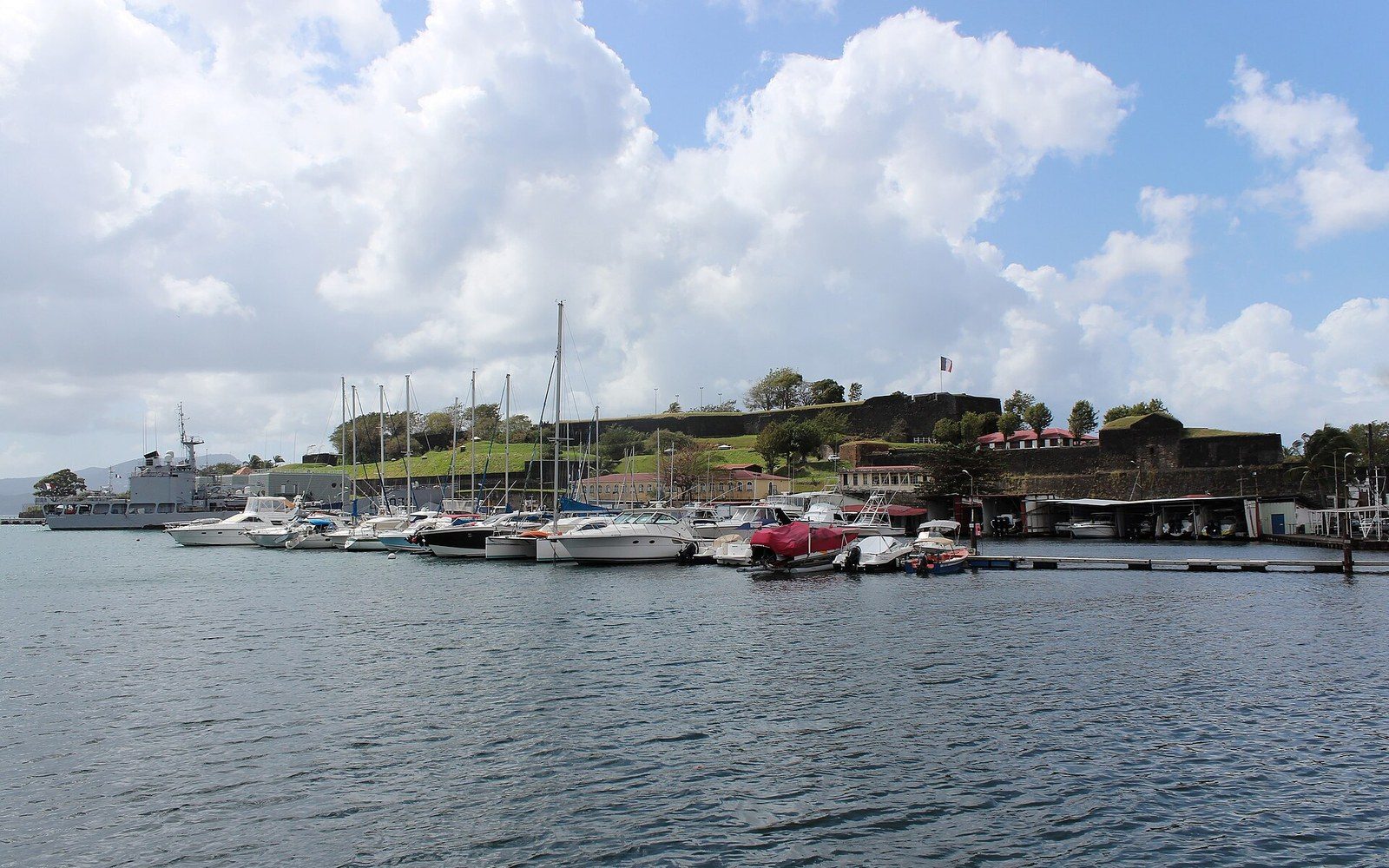
Islands that use the euro — Guadeloupe and Martinique are departments of France inside the EU, so the border and the currency in the middle of the arc are European ones.
Fort-de-France - 2014 - Fort Saint-Louis (3) · Wikimedia Commons
Fifteen member states now sit under the CARICOM umbrella, ranging from Belize on the Central American coast to Barbados and the Anglophone islands of the Eastern Caribbean, with Haiti admitted in 2002 as the organisation's only French-speaking full member. The Organisation of Eastern Caribbean States — the OECS, a tighter inner grouping of eight smaller islands — sits inside CARICOM rather than alongside it, its members sharing a central bank, a common currency pegged to the US dollar, and, since 2011, a treaty right to move and work freely across OECS territory without restriction. The layering of OECS inside CARICOM captures the organisation's enduring problem in miniature: the smaller, more vulnerable islands have often found it easier to integrate with each other than to bring the larger economies into the same system.
The single market and its gaps
The ambition was upgraded formally in 2006, when the CARICOM Single Market and Economy — the CSME — came into force among twelve of the fifteen members. The CSME was intended to allow free movement not just of goods but of skilled workers, services, capital and the right of establishment: in other words, a Caribbean equivalent of the European single market, scaled to a region of small economies whose combined population is a small fraction of Europe's. The International Monetary Fund has periodically noted the fragmentation of Caribbean economies and the potential gains from deeper integration, and the CSME was the instrument through which those gains were supposed to materialise.
Implementation has been slow and uneven. Free movement of skills operates through a certificate scheme: workers in a defined list of categories — graduates, media workers, musicians, nurses, teachers, sportspeople and several others — are entitled to a CARICOM Skills Certificate that allows them to seek employment across member states. In practice the scheme has worked imperfectly, with bureaucratic friction at national borders, inconsistent recognition of qualifications, and individual member states applying their own interpretations of what the certificate entitles its holder to do. The Caribbean Court of Justice, established in 2001 and based in Port of Spain, has jurisdiction over CSME disputes and has issued rulings affirming movement rights in specific cases, confirming that the right exists in law even when it is not honoured in practice.
Trade in goods within CARICOM has long been subject to a common external tariff — the CET — which determines what member states charge on imports from outside the region. But intra-regional trade remains a small fraction of what most members actually export, because the islands broadly produce and export the same things: bananas, tourism services, and in Trinidad's case hydrocarbons. Where one island makes something another needs, trade flows; where two islands both grow the same crop or both sell hotel beds to the same markets, integration offers less. The structural similarity of the economies is not a bureaucratic failure but a geographical and historical one, rooted in the plantation logic that shaped each island's production from the seventeenth century onward.
What has actually worked
CARICOM's functional cooperation record is more defensible than its single-market record. The Caribbean Public Health Agency, CARPHA, coordinates disease surveillance across the region. The Caribbean Disaster Emergency Management Agency, CDEMA, runs regional emergency response. The Caribbean Examinations Council, CXC, administers secondary-school certification across member states using common syllabuses and standards — a genuine act of harmonisation that shapes the educational experience of hundreds of thousands of young people each year. These institutions are not glamorous, but they work, and they represent something harder to build than a free-trade agreement: shared technical bureaucracy that member states actually use.
On 4 July 1973, four governments — Barbados, Guyana, Jamaica and Trinidad and Tobago — signed the Treaty of Chaguaramas in Trinidad, bringing the Caribbean Community into existence.
CARICOM as a bloc has also punched above its weight in multilateral forums. The region's coordinated position on climate change — consistently pressing for recognition of the specific vulnerability of small island developing states — has been a feature of international negotiations since at least the 1990s, and the Alliance of Small Island States, AOSIS, in which CARICOM members are prominent, has shaped the language of successive UN climate agreements. At the World Trade Organization, CARICOM members have acted collectively on the disputes that mattered most to their export economies, most visibly during the banana trade conflicts of the 1990s when the preferential access that several Eastern Caribbean islands held in the European market came under legal challenge.
The structural limits
Beneath every institutional discussion sits a fact that CARICOM cannot change: these are mostly very small, very open economies whose governments raise revenue from the same trade they are trying to liberalise. A tariff is not just a trade policy instrument; for several CARICOM members it is a significant budget line. Reducing it requires finding replacement revenue, and the fiscal arithmetic is difficult. Haiti adds a further dimension: the region's largest population by some margin, chronically unstable, and not integrated in any practical sense into the mechanisms the CSME envisions.
The Treaty of Chaguaramas was revised in 2001 to create the legal architecture of the CSME, and the revised treaty is explicit about what full integration would require. The gap between that architecture and daily reality is not primarily a drafting failure. It reflects the difficulty of integrating economies that arrived at political independence at different times, retained different metropolitan ties — the French departments of Guadeloupe and Martinique are not CARICOM members at all, structurally sealed off by their status inside the EU — and whose governments are accountable to national electorates with their own priorities. The Caribbean Court of Justice, the Caribbean Development Bank, the Eastern Caribbean Central Bank: the institutions exist and do real work. The question is not whether the region has built institutions. It is whether fifty years of building them has been enough to close a single market that remains, in important respects, more treaty than fact.