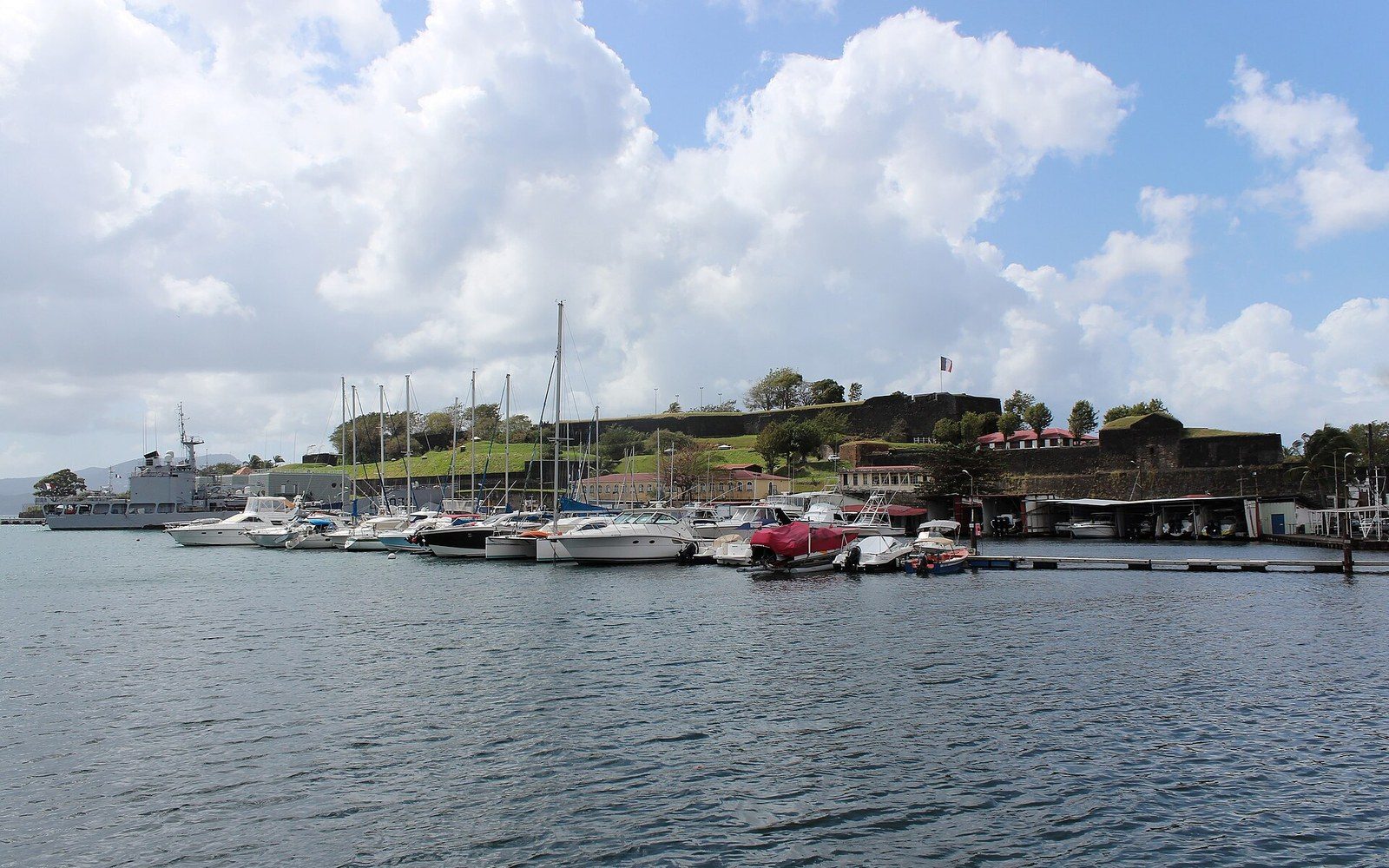
France in the middle of the arc
The Lesser Antilles are not uniformly Caribbean in any jurisdictional sense. Midway down the volcanic arc, between Montserrat to the north and St Lucia to the south, sit two islands — Guadeloupe and Martinique, with Dominica lying between them — — that are not overseas territories or associated states of France. They are France: full départements d'outre-mer (overseas departments), with the same constitutional status as Normandy or Brittany. Their residents are EU citizens, their currency is the euro, and their external border is an EU external border.
This matters structurally. The Eastern Caribbean dollar, pegged to the US dollar and issued by the Eastern Caribbean Central Bank, governs most of the smaller islands in the arc. CARICOM runs on a different monetary logic. Guadeloupe and Martinique operate entirely outside that framework, aligned instead with the European Central Bank and the Schengen conversation — though neither island is in the Schengen Area, a distinction the EU maintains between monetary union and passport-free travel. What they do share with continental Europe is the single currency and full access to EU structural funds, which have shaped everything from road infrastructure to university provision.
The practical consequence is a visible economic discontinuity on a relatively small stretch of ocean. A ferry crossing between Martinique and the independent island of Dominica crosses not just a national boundary but a monetary union boundary and a development-model boundary simultaneously. Wages in Martinique are calibrated to French labour law and the French minimum wage; prices reflect European supply chains and VAT. For neighbouring islands trading informally across that passage, the asymmetry is constant and tangible.
Geologically the two islands are as volcanic as the rest of the arc. Martinique's Mount Pelée, which destroyed the city of Saint-Pierre in 1902, remains one of the most consequential eruptions in Caribbean recorded history. Guadeloupe's Soufrière volcano is classified as an active system and was the subject of a large-scale evacuation in 1976. The European institutional framework does not change the subduction zone underneath.
What it does change is disaster response. French departmental status means that emergency civil protection, public finance for reconstruction, and scientific monitoring by national agencies — specifically the Observatoire Volcanologique et Sismologique de la Martinique and its Guadeloupe counterpart — operate under French state budgets rather than the constrained fiscal envelopes of small island governments. The contrast with the resource position of independent neighbours during comparable crises is sharp.
Neither island is a special economic zone or an experiment in autonomy. They are, in the language of EU law, outermost regions — a category that permits some adaptations to EU rules while keeping the fundamental framework intact.