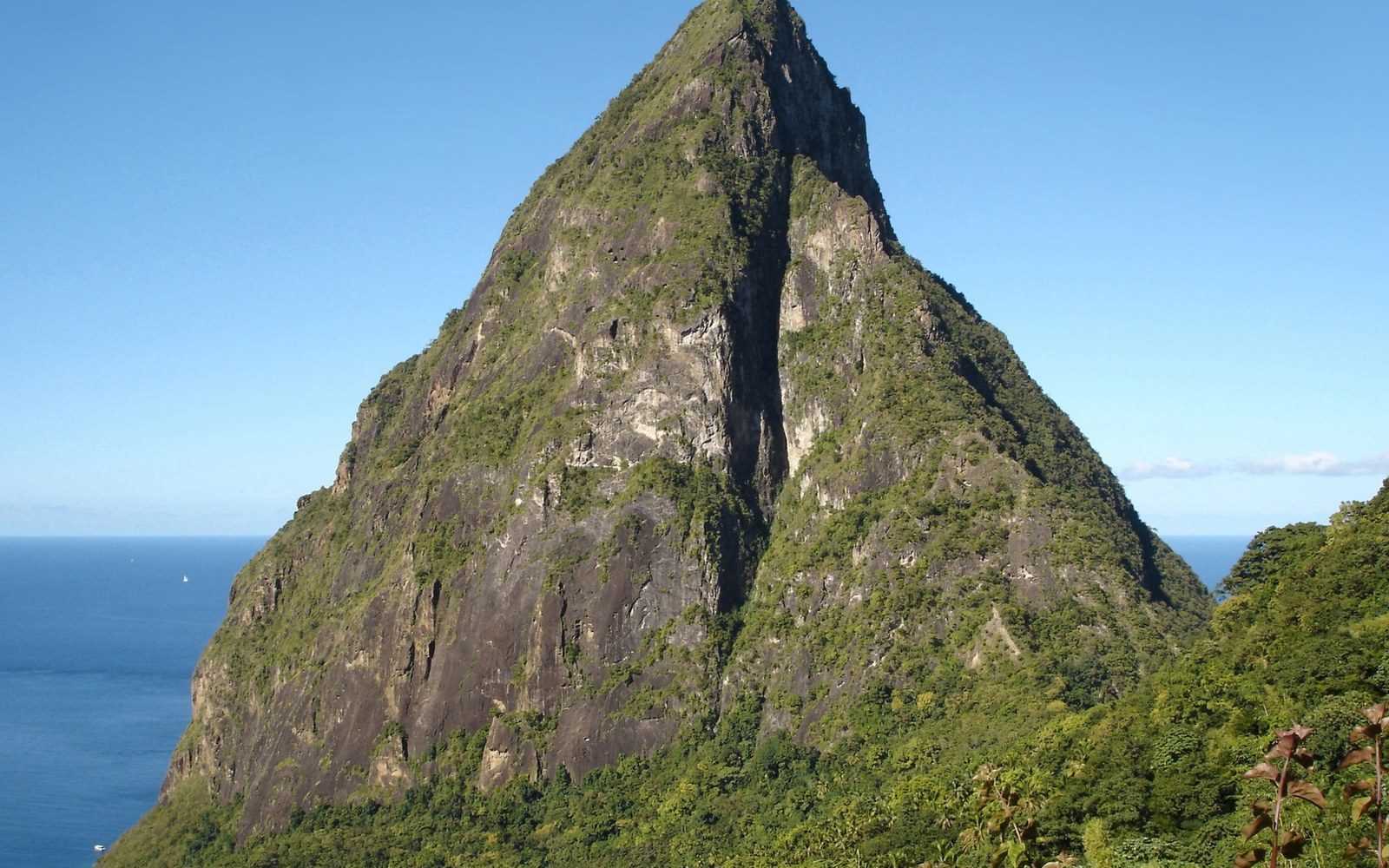
What the Pitons Actually Are
Gros Piton and Petit Piton rise from the sea on St Lucia's south-west coast with an abruptness that reads as theatrical but is, in fact, structural. They are volcanic plugs — the solidified magma that once filled the conduit of a volcano, left standing after the surrounding cone eroded away over millions of years. Gros Piton reaches roughly 798 metres, Petit Piton around 743 metres, and the near-vertical flanks of both are the result of the lava's original viscosity: material that thick does not spread; it hardens in place and waits for the softer rock around it to weather down. The two plugs are not isolated curiosities but part of a broader volcanic field that also includes the Qualibou caldera — a collapsed volcanic depression that underlies the nearby town of Soufrière and its sulphur springs. St Lucia sits on the Lesser Antilles arc, where the Atlantic plate subducts beneath the Caribbean plate and has been building island after island for tens of millions of years.
The World Heritage Designation
In 2004, UNESCO inscribed the Pitons Management Area as a World Heritage Site — not just the two plugs but a zone of roughly 2,909 hectares of land and an adjacent marine area. The criteria cited were geological and biological: the plugs as outstanding examples of volcanic landforms, the surrounding forest carrying high endemic biodiversity, and the coral reef system in the waters between and below the two formations. The inscription means that UNESCO exercises a standing interest in any major development within or adjacent to the buffer zone. St Lucia's own planning authority cannot simply approve a large coastal hotel or a road-widening scheme in this corridor and leave it there; projects judged to affect the Outstanding Universal Value of the site require notification, and in some cases reactive monitoring missions.
That leverage has been used. The buffer zone has generated recurring friction between conservation obligations and the economic pressure to build. St Lucia's economy, like most of its neighbours in the Eastern Caribbean, shifted toward tourism after agriculture contracted, and the Pitons viewshed is among the most commercially valuable on any island in the region. The tension is not abstract: development proposals near Soufrière have been scrutinised precisely because the designation gives conservationists and the World Heritage Committee a formal mechanism that local planning approvals alone would not provide.
The Geology Underneath the View
The Qualibou caldera is still geothermally active. The sulphur springs at Sulphur Springs Drive — promoted locally as a drive-in volcano — are surface expressions of the same heat system. Hot springs, fumaroles and altered ground are distributed across this part of the island in a pattern that resembles, at smaller scale, what is found further north in Dominica's geothermal landscape. The rock beneath Soufrière has been so thoroughly mineralised by hydrothermal fluids over geological time that its physical properties differ markedly from the unaltered volcanic material of the plugs themselves. The plugs, by contrast, are dense and resistant — which is why they are still there.
That density makes Gros Piton climbable. A guided trail to its summit is one of the documented ascents in the Eastern Caribbean, rewarding in direct proportion to the humidity and steepness. Petit Piton is a technical climb and rarely summited. Neither fact has much bearing on the conservation regime: what the listing protects is the integrity of the landforms and their setting, assessed against defined criteria by the World Heritage Committee, not their accessibility to visitors.
The Pitons are the most photographed features of St Lucia because they are genuinely extraordinary. The listing exists because extraordinary is not, by itself, a protection.