From the Canboulay to the Contemporary Street
The event's roots lie in the years immediately following emancipation in 1834. Enslaved people had been excluded from the pre-Lenten masked balls of the French Creole planter class; freed people responded by appropriating and transforming the space. Canboulay — from cannes brûlées, burned cane — was a torchlit procession that commemorated the night-time running to fight plantation fires, where enslaved gangs had been driven under compulsion. After emancipation it became a defiant re-enactment, noisy and collective, and colonial authorities understood it as a threat. The Canboulay Riots of 1881, when Port of Spain's police captain Arthur Baker attempted to suppress the procession and was driven back by the crowd, mark one of the clearest documented collisions between official suppression and popular cultural assertion in the Caribbean record. The British colonial administration moved in subsequent years to ban drumming and torch-carrying, which had the unintended effect of pushing musical invention in new directions.
Calypso formalised from the kaiso tradition, a sung commentary rooted in West African griot practice, delivered in the patois of the colonial street and sharpened against censorship. The Calypso Tent — a performance venue in which singers competed and crowds judged — was the institution that allowed the form to develop technically while remaining politically barbed. Calypsonians such as Wilmoth Houdini and the Roaring Lion were working this circuit by the 1930s, and recordings carried the form to the diaspora. The competition structure that resulted in the annual Calypso Monarch title remains intact today, administered through the National Carnival Commission of Trinidad and Tobago, a statutory body established in 1991.
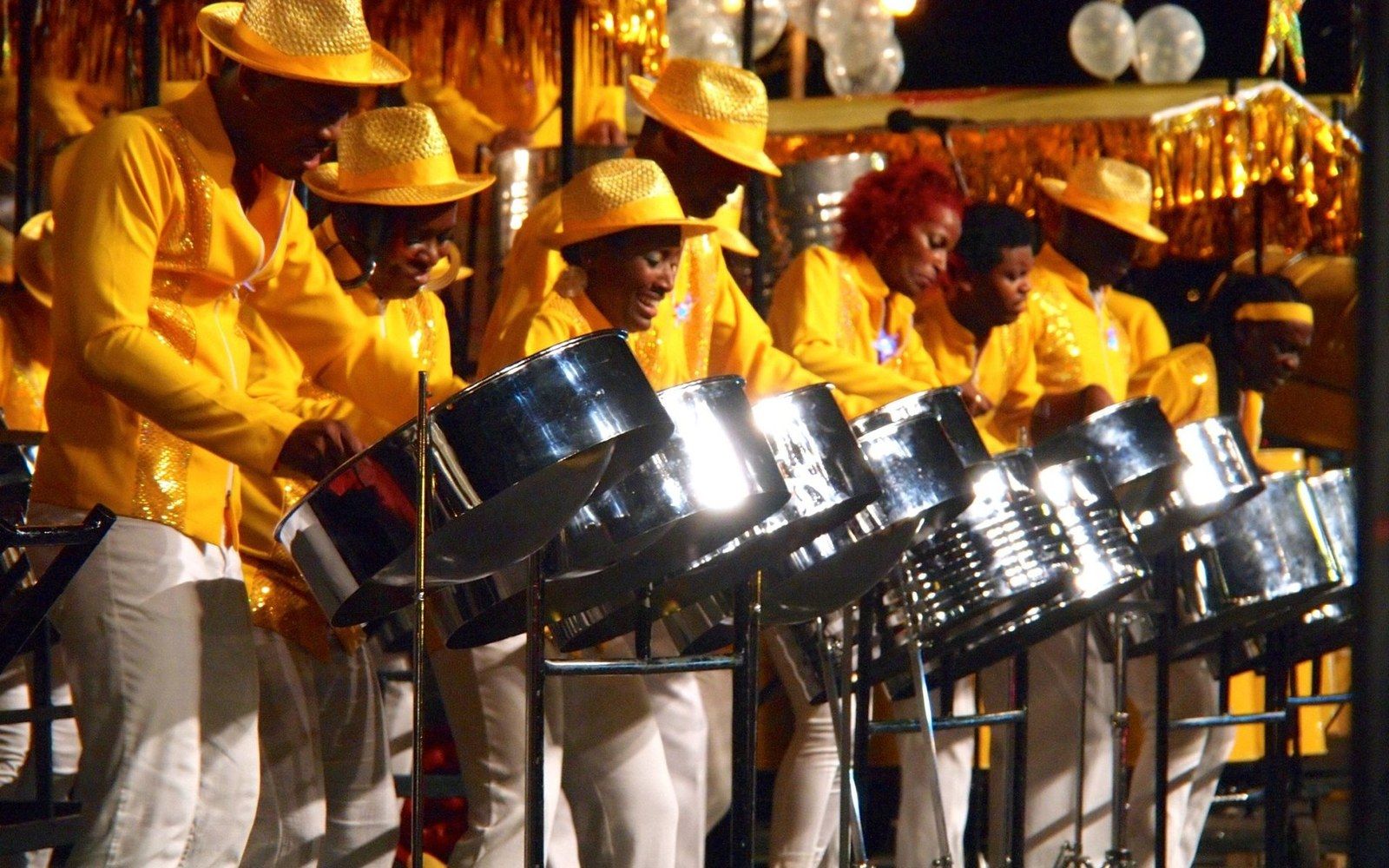
Steelpan — the only acoustic instrument widely accepted as having been invented in the twentieth century — emerged in the late 1930s and 1940s from the Laventille and Belmont districts of Port of Spain, where young men, largely shut out of formal musical institutions, discovered that the steel drums and biscuit tins left by the American military presence during the Second World War could be tuned by controlled hammering. The developmental sequence from single-note boom to fully chromatic tenor pan is documented in detail at the University of the West Indies collections, which hold oral histories and early instruments. Pan yards — the open rehearsal spaces where bands prepare — remain the structural unit of steelpan culture; the Panorama competition, which tests large orchestras playing arrangements of Carnival compositions, has run annually since 1963.
Mas — the masquerade — carries the most architecturally complex lineage. The wire-bending and papier-mâché traditions of the large individual costume, developed by designers such as George Bailey and Carlisle Chang in the 1950s, represent a distinct craft practice. The National Museum and Art Gallery of Trinidad and Tobago holds documentation of historic band presentations. Peter Minshall, who has designed mas bands continuously since the 1970s and also designed opening ceremonies for the 1992 Barcelona and 1996 Atlanta Olympics, represents the point where Carnival design crossed into internationally recognised art practice without leaving its source. His Mancrab and Washerwoman figures, and the philosophical content of bands such as River and Tantana, are documented in the Trinidad and Tobago National Carnival Commission's archive.
The sequence matters because it separates Trinidad Carnival from events elsewhere that carry the same name but different histories. Carnival in Guadeloupe and Martinique is shaped by French departmental administration; other regional carnivals derive from tourism-driven reconstruction of fragmentary traditions. Trinidad's version predates the tourism economy, was shaped by the people who were suppressed under colonialism, and has generated the institutional infrastructure — the Calypso Monarch, Panorama, the King and Queen of the Bands competition — that gives it a competitive and archival structure. None of that was designed to attract outsiders. The outsiders came because the thing was already there.